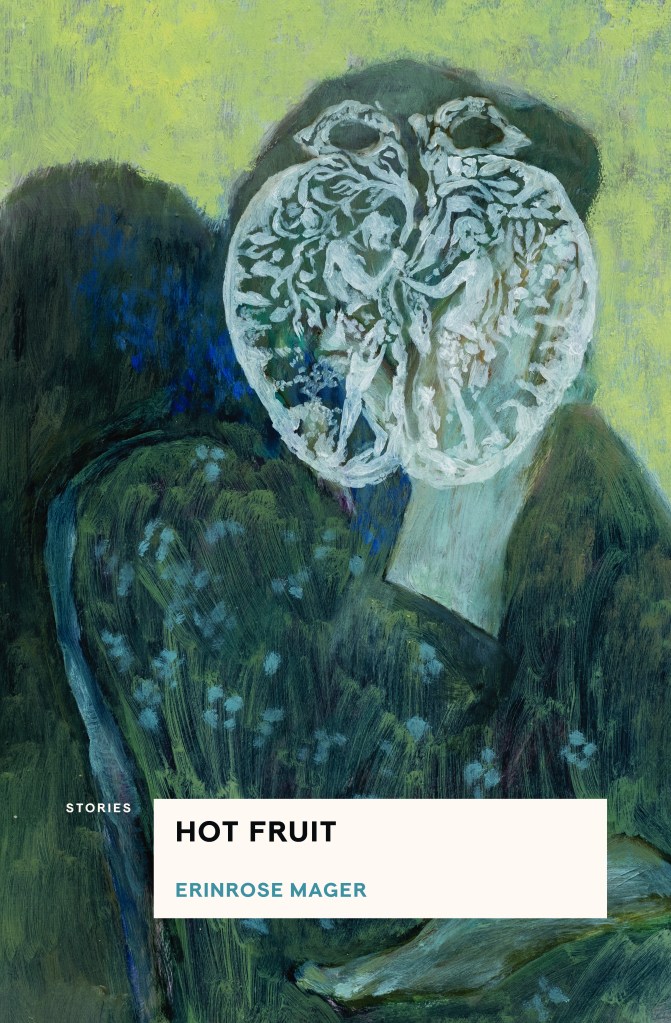
Hot Fruit is my first book, a collection forthcoming from Fonograf Editions in 2026. It is now available for pre-order.
Advance praise for Hot Fruit:
The “here” of the stories in Hot Fruit, these bursts of “desperate, enigmatic poetry,” is a fabulist space of possibility, a world of “sudden double exposure” where to think a thing is to make it so. Who are we, here, and who could love us? The spectral parents? Or spectral gods? Can they fill the unfillable void of desire? Like some chimeric offspring of Diane Williams, Donald Barthelme, and Marguerite Duras, Erinrose Mager is dreamlike, frightening, tragic, very funny, and totally singular.
—Elisa Gabbert, author of Any Person Is the Only Self
In prose that is meticulous and exacting, Erinrose Mager writes of the strange and surreal. It is that wonderful mix of qualities that lends a dreaminess to stories that bite.
—Amina Cain, author of Indelicacy
Hot Fruit is an enthralling and virtuosic ode to the dark and ecstatic entanglements of the Korean adoptee diaspora. A collage of fable, absurdity, and in-between-ness, Erinrose Mager’s self-contained worlds conjure many moods. A gorgeous and vital debut.
—Patrick Cottrell, author of Afternoon Hours of a Hermit
The stories in Hot Fruit are almost painfully good—weird, smart, hilarious, sad—they stunned me. I kept thinking of Donald Barthelme’s idea that literature’s aim is “the creation of a strange object covered with fur which breaks your heart.” If that’s the sort of literature you’ve been looking for, here it is!
—Danielle Dutton, author of Prairie, Dresses, Art, Other
The fictions and fables in Erinrose Mager’s Hot Fruit are gem-like studies of intimacy and of familial connections in all their paradoxical and enigmatic complexities. As much as these stories are steeped in distance—at times geographical, physical, and at others, metaphorical, casting light on the unknowability of another—they are also suffused by acts of care. Grief and loss are rendered so tenderly that the love at the source is ever-present.
The foundational relationship at the heart of this book is the motherless child. Abandoned, lost in the woods, or separated by oceans, the motherless child seeks intimacy, but instead finds strangeness. Between parents and children, spouses, siblings, friends and neighbors, we see the deep ties that compel these characters together, even as the contact they truly crave eludes them.
In “Warp of a Fabric,” the speaker observes, “As they’ve only known only distance, they’re unsure of how to cross it. They can just approach.” Here then is Mager’s invitation to enter these beautiful, haunting reveries on love and intimacy, saturated and made sacred by their deep humanity.
—Mary-Kim Arnold, author of The Fish & the Dove